
2027 Toyota Aqua Introduction – The Toyota Aqua has become one of the most successful hybrid hatchbacks in Japan, earning widespread recognition for its outstanding fuel efficiency, compact dimensions, dependable engineering, and affordable ownership costs. Known as the Prius C in several international markets during its first generation, the Aqua has evolved into a modern urban vehicle that perfectly reflects Toyota’s leadership in hybrid technology. For drivers seeking economical transportation without sacrificing comfort or practicality, the Aqua has consistently remained one of the most compelling choices in its segment.
As Toyota accelerates its commitment to electrification, anticipation is growing around what the 2027 Toyota Aqua might offer. Although the current generation remains highly competitive, advancements in battery technology, digital connectivity, and driver assistance systems have created expectations that Toyota will continue refining its popular hybrid hatchback. At the time of writing, however, Toyota has not officially announced a 2027 Toyota Aqua or released confirmed specifications, pricing, or launch details.
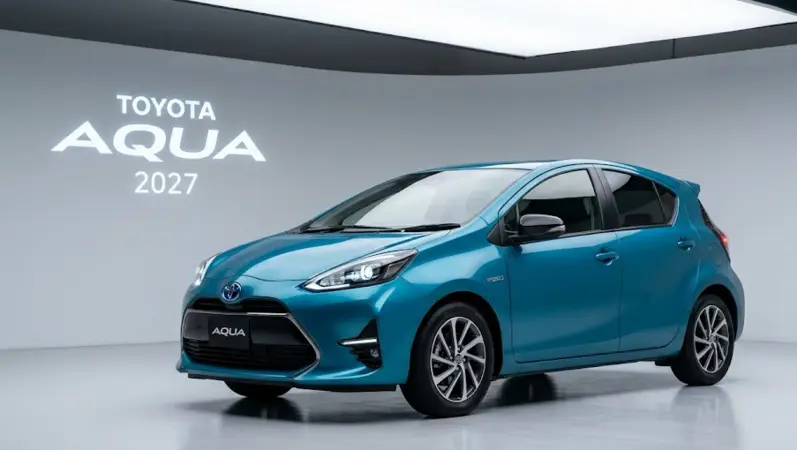
The information discussed throughout this article is therefore based on industry expectations, current Toyota development trends, and broader market analysis rather than official confirmation. If Toyota follows its well-established philosophy of continuous improvement, the 2027 Toyota Aqua could become an even more efficient, technologically advanced, and refined version of one of the world’s most respected compact hybrid vehicles.
Few manufacturers have influenced the development of hybrid technology as profoundly as Toyota. From the original Prius to today’s extensive lineup of electrified vehicles, the company has consistently demonstrated that fuel efficiency, reliability, and environmental responsibility can coexist without compromising everyday usability.
The Toyota Aqua embodies that philosophy particularly well. Designed primarily for urban environments, it offers compact dimensions that simplify city driving while providing exceptional fuel economy and low operating costs. These qualities have made the Aqua especially attractive to commuters, first-time buyers, small families, and environmentally conscious drivers.
The automotive market has evolved rapidly over the past several years. Consumers now expect compact vehicles to deliver advanced safety systems, seamless smartphone integration, premium cabin quality, and increasingly sophisticated hybrid technology. Toyota has responded by steadily improving nearly every aspect of its global product lineup, making it reasonable to expect meaningful updates for the next Aqua whenever it arrives.
Should the 2027 Toyota Aqua become reality, it would likely continue focusing on intelligent efficiency while incorporating improved digital technology, greater passenger comfort, enhanced refinement, and the latest evolution of Toyota’s hybrid engineering.
2027 Toyota Aqua Redesign
Toyota has not officially revealed a redesigned Aqua for the 2027 model year, but industry analysts expect the company to continue refining the current generation through carefully considered updates rather than pursuing a radical transformation.
The exterior could adopt a cleaner interpretation of Toyota’s latest design language. A revised front fascia featuring slimmer LED headlights, a more sculpted bumper, and a wider grille treatment may create a more dynamic appearance while simultaneously improving aerodynamic performance.
Aerodynamics have always played an essential role in hybrid vehicle efficiency, and Toyota is expected to continue optimizing airflow around the vehicle. Revised side mirrors, smoother body contours, redesigned wheel designs, and improved underbody panels could all contribute to lower drag, quieter highway cruising, and enhanced fuel economy.
Viewed from the side, the Aqua would likely retain its compact proportions while introducing sharper character lines and more expressive wheel arch styling. New alloy wheel options and expanded exterior color choices could also offer buyers additional personalization options.
The rear design may feature slimmer LED taillights connected through a cleaner visual theme, accompanied by revised bumper detailing and subtle aerodynamic enhancements that reinforce the hatchback’s modern identity.
Technology is expected to represent one of the most significant areas of improvement. Toyota could introduce updated multimedia software with faster processing speeds, enhanced voice recognition, expanded cloud-based services, wireless software updates, and more intuitive user interfaces that simplify daily operation.
Driver assistance systems are also likely to receive meaningful enhancements. Although Toyota has not confirmed any specific features, industry experts anticipate further improvements to adaptive cruise control, lane-centering assistance, pedestrian detection, automatic emergency braking, and intelligent parking support.
2027 Toyota Aqua Exterior and Interior
Compact dimensions have always been one of the Aqua’s greatest strengths. The 2027 model is expected to preserve these advantages while presenting a noticeably more refined appearance.
The front end may become more expressive through slimmer lighting elements and improved LED technology that enhances visibility while giving the hatchback a more premium daytime signature. Depending on trim level, adaptive headlights and redesigned daytime running lights could become available to improve both safety and aesthetics.
Toyota may also introduce revised alloy wheel designs ranging from practical aerodynamic options to sportier premium finishes. Combined with updated paint colors and contrasting roof options on selected trims, these changes could make the Aqua more visually appealing to younger buyers.

Inside, Toyota is expected to continue elevating cabin quality. Soft-touch dashboard materials, redesigned door panels, improved upholstery, and enhanced fit and finish could make the interior feel significantly more upscale than previous generations while maintaining durability suitable for everyday use.
The dashboard will likely feature Toyota’s latest infotainment platform on a larger, high-resolution touchscreen. expected to remain available, alongside cloud-connected navigation, voice assistant integration, and expanded connected vehicle services.
A fully digital instrument cluster could become available on higher trim levels, offering customizable layouts that display navigation instructions, hybrid system information, efficiency statistics, safety alerts, and entertainment controls in a clear, intuitive format.
Passenger comfort may also improve through redesigned front seats offering better lumbar support and more effective cushioning during longer journeys. Despite the vehicle’s compact exterior dimensions, Toyota is expected to continue maximizing interior space through intelligent packaging and efficient cabin design.

Rear-seat passengers could benefit from improved seat ergonomics, additional charging ports, and more convenient storage solutions. Cargo capacity is also expected to remain highly practical, allowing the Aqua to accommodate grocery shopping, weekend luggage, and everyday transportation needs with ease.
Acoustic refinement will likely receive additional attention. Improved insulation materials, thicker glass, and revised sealing techniques could reduce wind and road noise, creating a noticeably quieter driving environment than previous models.
Safety will almost certainly remain one of the Aqua’s defining strengths. Although Toyota has released no official equipment list, the latest generation of Toyota Safety Sense includes lane departure prevention, lane tracing assistance, and traffic sign recognition in selected models.
2027 Toyota Aqua Engine and Performance
Hybrid technology has always defined the Toyota Aqua, and the 2027 model is expected to continue showcasing Toyota’s expertise in efficient electrified powertrains.
Toyota has not officially confirmed mechanical specifications for a future Aqua. However, many automotive analysts expect the hatchback to continue to use an updated version of Toyota’s proven hybrid system, featuring a naturally aspirated gasoline engine paired with an improved electric motor and more advanced battery technology.
One area where Toyota may introduce meaningful improvements is battery efficiency. The company has already pioneered the use of advanced bipolar nickel-metal hydride batteries in certain Aqua models, and future developments could further improve power delivery, charging efficiency, and long-term durability.
Software refinements may also enhance interaction, acceleration, quieter operation, and even better fuel economy during stop-and-go city driving. The continuously variable transmission is expected to remain in use due to its proven compatibility with Toyota’s hybrid systems. Future calibration improvements could provide a more natural acceleration while minimizing engine noise at higher throttle inputs.
Ride quality should also continue improving. Revised suspension tuning, enhanced chassis rigidity, and optimized steering calibration could deliver greater confidence on highways while preserving the comfortable ride characteristics that urban commuters appreciate.
The Aqua has never been designed as a performance hatchback, and that philosophy is unlikely to change. Instead, Toyota will probably continue emphasizing predictable handling, effortless drivability, and exceptional efficiency.
Fuel economy will undoubtedly remain one of the vehicle’s greatest selling points. Although Toyota has not released official figures for any future model, industry observers expect the 2027 Aqua to deliver even greater efficiency than the current generation thanks to ongoing advancements in hybrid engineering and energy management software.
Multiple selectable driving modes may also remain available, allowing drivers to prioritize maximum efficiency, balanced everyday performance, or more responsive acceleration depending on traffic conditions.
Overall, the 2027 Toyota Aqua is expected to offer a remarkably refined driving experience that combines quiet operation, smooth power delivery, excellent fuel economy, and the long-term reliability synonymous with Toyota hybrid vehicles.
2027 Toyota Aqua Price and Release Date
Because Toyota has not officially announced the 2027 Toyota Aqua, all pricing and launch information currently remains speculative. Industry analysts expect Toyota to maintain the Aqua’s position as an affordable hybrid hatchback while incorporating modest price increases to reflect updated technology and additional equipment.
Depending on market conditions and trim levels, entry-level models could reasonably start at $18,000 to $21,000, while higher-specification variants with advanced safety features, premium interiors, and enhanced infotainment systems may range from $22,000 to $27,000. These figures represent informed estimates and should not be interpreted as official pricing.
Regarding availability, many automotive observers believe Toyota could introduce an updated Aqua sometime during late 2026 or early 2027, although no official production schedule or reveal date has been announced. Consequently, all release expectations discussed here remain speculative until Toyota provides formal confirmation.
Regional availability is expected to continue focusing primarily on Japan and selected international markets where compact hybrid vehicles remain in strong demand.
2027 Toyota Aqua Personal Note
The Toyota Aqua demonstrates that meaningful automotive innovation does not always require larger vehicles or more powerful engines. Its success has come from delivering exactly what millions of drivers value most: outstanding fuel efficiency, dependable engineering, affordable ownership, and practical everyday usability.
As long as compact hybrid hatchbacks continue growing, models like the Aqua are likely to become even more relevant. Toyota’s decades of experience developing hybrid technology place the company in an exceptionally strong position to continue leading this segment.
If the 2027 Toyota Aqua builds on the strengths of the current generation while introducing smarter digital technology, greater cabin refinement, improved safety systems, and further advancements in hybrid efficiency, it could once again establish itself as one of the best compact hybrid vehicles available worldwide.
Although Toyota has yet to confirm the existence of a 2027 model, expectations remain highly encouraging. By continuing its tradition of thoughtful engineering and incremental refinement rather than unnecessary reinvention, Toyota has every opportunity to ensure that the next Aqua remains a benchmark for efficiency, reliability, and intelligent urban mobility. For commuters, young professionals, environmentally conscious drivers, and anyone seeking dependable transportation with exceptionally low running costs, the future Toyota Aqua promises to remain one of the smartest choices in the compact hatchback market.
Also read the article : https://cagecars.com/2027-toyota-axio-everything-we-expect-from-this/