
2027 Toyota bZ4X Range Introduction – Toyota’s transition to battery-electric vehicles has accelerated considerably over the past few years, and the bZ4X stands at the center of that transformation. As the company’s first globally marketed electric SUV built on the dedicated e-TNGA platform, the bZ4X has demonstrated Toyota’s commitment to combining dependable engineering with practical zero-emission mobility. With electric vehicle technology advancing at an unprecedented pace, many prospective buyers are now asking one important question: how far will the 2027 Toyota bZ4X travel on a single charge?
Although Toyota has not officially announced the 2027 Toyota bZ4X or released confirmed specifications regarding battery capacity, driving range, charging performance, or pricing, industry expectations suggest that the next evolution of Toyota’s electric SUV could deliver meaningful improvements in every major area. This article explores what the 2027 Toyota bZ4X Range might look like based on Toyota’s current development strategy, publicly discussed battery technologies, and broader trends shaping the global EV market. Any technical specifications, estimated range figures, pricing, or launch information presented here should be viewed as informed expectations rather than confirmed facts.
Range has become one of the defining benchmarks in today’s electric vehicle market. While early EV buyers were primarily concerned with reducing emissions, modern consumers increasingly expect electric SUVs to offer the confidence of long-distance travel, rapid charging, intelligent energy management, and dependable real-world performance across varying weather conditions.
Toyota understands these expectations better than most manufacturers. The company spent more than two decades refining hybrid technology before significantly expanding into fully electric vehicles. That measured approach has allowed Toyota to accumulate extensive expertise in battery durability, thermal management, electric motor efficiency, and energy optimization areas that directly influence driving range.
The current Toyota bZ4X already delivers a practical balance of comfort, efficiency, and everyday usability. However, the pace of battery development across the industry suggests that future models could achieve significantly longer driving distances while simultaneously reducing charging times and improving long-term battery health.
If Toyota introduces a redesigned or substantially updated bZ4X for the 2027 model year, driving range will almost certainly become one of its most important selling points. Rather than chasing unrealistic headline numbers, Toyota is expected to focus on delivering dependable, repeatable efficiency that owners can rely on in everyday driving.
2027 Toyota bZ4X Range Redesign
Toyota has not officially revealed design details for the 2027 Toyota bZ4X, but automotive analysts widely expect the electric SUV to receive a comprehensive refresh that enhances both visual appeal and aerodynamic efficiency.
Aerodynamics play a crucial role in determining an electric vehicle’s driving range. Even relatively small improvements to airflow management can significantly reduce energy consumption at highway speeds. As a result, Toyota is expected to refine nearly every exterior surface with efficiency in mind.
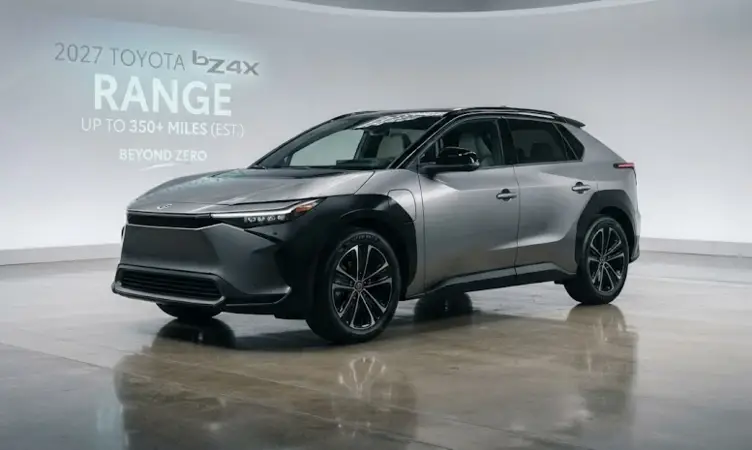
The front fascia could feature slimmer adaptive LED headlights, a smoother bumper design, and revised air channels that direct airflow more effectively around the front wheels. Since battery-electric vehicles require less cooling than conventional gasoline models, Toyota may further reduce the size of exterior air openings to minimize drag.
The side profile will likely maintain the bZ4X’s distinctive crossover proportions while introducing flush door handles, redesigned aerodynamic mirrors, optimized wheel designs, and smoother body sculpting. These refinements would not only modernize the SUV’s appearance but could also contribute to measurable improvements in energy efficiency.
At the rear, revised LED lighting, a cleaner tailgate design, and a carefully integrated spoiler may help manage airflow more effectively while creating a more premium overall appearance. Toyota has increasingly emphasized elegant simplicity across its newest products, and the updated bZ4X is expected to continue that design philosophy.
Beyond exterior styling, Toyota may also introduce structural improvements through revised battery packaging, lighter materials, and enhanced chassis rigidity. These changes could reduce overall vehicle weight while improving ride quality, handling, and efficiency.
Software will likely become an even more important component of the redesign. Over-the-air updates, intelligent battery management, predictive navigation with charging integration, and adaptive energy optimization could help the vehicle become more efficient throughout its ownership.
2027 Toyota bZ4X Range Exterior and Interior
The current Toyota bZ4X already offers a spacious cabin thanks to its dedicated electric platform, and the 2027 model is expected to build upon that strength with greater refinement and improved technology.
From the outside, Toyota is likely to continue emphasizing sophisticated, timeless styling rather than dramatic futuristic design. Updated LED lighting signatures, redesigned alloy wheels, fresh paint colors, and improved aerodynamic detailing could give the SUV a more premium appearance while supporting greater driving efficiency.
Premium trim levels may introduce panoramic glass roofs, contrasting roof finishes, illuminated exterior accents, and larger aerodynamic wheel designs that combine visual appeal with optimized airflow.

Inside, Toyota is expected to introduce meaningful improvements in both materials and technology. A larger high-resolution infotainment display featuring the company’s newest multimedia software could offer faster processing speeds, enhanced voice recognition, and expanded over-the-air update capability.
The digital instrument cluster may become more customizable, allowing drivers to prioritize navigation, charging status, remaining range, energy consumption, regenerative braking information, and advanced safety alerts to suit personal preferences.
Interior materials are also expected to evolve. Toyota has increasingly emphasized environmentally responsible manufacturing, making it likely that recycled textiles, premium synthetic leather, renewable trim materials, and sustainable production methods will become even more prominent throughout the cabin.

Passenger comfort should improve through redesigned seats with enhanced lumbar support, additional adjustment options, and better cushioning for extended journeys. Improved sound insulation, thicker acoustic glass, and refined door sealing techniques could further reduce road and wind noise, creating an exceptionally quiet environment that complements the silent operation of an electric powertrain.
Storage practicality is expected to remain one of the bZ4X’s greatest strengths. Clever center-console organization, generous cargo capacity, multiple USB-C charging ports, wireless smartphone charging, and flexible rear-seat configurations should continue to make the SUV highly practical for both families and commuters.
Toyota Safety Sense will almost certainly receive another significant update. Although Toyota has not released official equipment details, industry analysts expect improvements to adaptive cruise control, lane-centering assistance, blind-spot monitoring, automatic emergency braking, traffic-jam assistance, intelligent parking systems, and enhanced driver-monitoring technology.
2027 Toyota bZ4X Range Engine and Performance
The defining topic surrounding the 2027 Toyota bZ4X is undoubtedly its expected driving range. Toyota has not confirmed battery specifications for the 2027 model. Nevertheless, industry experts widely anticipate substantial improvements in battery chemistry, thermal management, and energy density that could directly increase real-world range.
Many analysts believe Toyota may introduce a larger-capacity lithium-ion battery featuring improved cooling systems and more efficient energy management software. Such advancements could enable the bZ4X to travel significantly farther without dramatically increasing battery size.
Current industry expectations suggest that the 2027 Toyota bZ4X could achieve an estimated driving range of 350 to 420 miles, depending on battery capacity, drivetrain configuration, wheel size, climate conditions, and official testing methodology. These figures remain speculative because Toyota has not released any official performance data.
Charging capability is also expected to improve considerably. Faster DC charging, more advanced battery preconditioning, improved thermal regulation, and intelligent charging software could substantially reduce charging times while helping preserve long-term battery health.
Toyota continues researching next-generation battery technologies, including solid-state batteries. While the company has publicly discussed progress in this field, it has not confirmed that solid-state batteries will appear in the 2027 bZ4X. Consequently, expectations regarding this technology remain speculative.
Front-wheel-drive and dual-motor all-wheel-drive configurations are expected to remain available. The all-wheel-drive version, benefiting from Toyota’s collaboration with Subaru, may receive updated traction management software that enhances efficiency while providing confident performance across varying road conditions.
Acceleration is expected to become smoother thanks to improved motor calibration and more sophisticated power delivery. Rather than prioritizing extreme performance, Toyota will likely continue emphasizing predictable, refined acceleration suitable for everyday driving.
Ride quality should also benefit from suspension refinements, lighter components, enhanced chassis rigidity, and improved weight distribution. Combined with the inherently low center of gravity provided by the battery pack, these improvements could make the 2027 bZ4X even more comfortable and confidence-inspiring during both city commuting and highway travel.
Regenerative braking may offer greater customization, allowing drivers to adjust energy recovery according to personal preference or driving conditions. Intelligent energy management software could further optimize efficiency by considering navigation routes, elevation changes, traffic conditions, and weather forecasts.
Overall, Toyota’s approach is expected to prioritize dependable efficiency, realistic driving range, long-term durability, and everyday usability rather than chasing headline acceleration figures.
2027 Toyota bZ4X Range Price and Release Date
As of now, Toyota has not officially announced the 2027 Toyota bZ4X or published pricing, specifications, or production timelines.
Based on current EV market trends and anticipated technological improvements, automotive analysts estimate that the entry-level 2027 Toyota bZ4X could start at approximately $43,000 to $47,000 in the United States. Higher trim levels, equipped with larger battery packs, premium interior features, advanced safety technologies, and dual-motor all-wheel-drive systems, could range from $50,000 to $60,000. These figures represent industry estimates and should not be interpreted as official pricing.
Regarding availability, many observers expect Toyota could reveal the updated bZ4X during late 2026, followed by production and customer deliveries throughout 2027. However, Toyota has not confirmed any official launch schedule, and release timing may vary depending on production capacity, battery supply, and regional market conditions.
Prospective buyers should therefore regard all pricing, range estimates, and launch expectations discussed here as informed projections until Toyota publishes official information.
2027 Toyota bZ4X Range Personal Note
The Toyota bZ4X represents far more than simply another electric SUV. It reflects Toyota’s deliberate and methodical approach to entering one of the automotive industry’s most competitive segments. Rather than rushing to produce headline-grabbing specifications, Toyota appears focused on delivering electric vehicles that offer the same qualities customers have trusted for decades: reliability, durability, efficiency, and confidence.
If the 2027 Toyota bZ4X achieves the improvements many industry analysts expect particularly in driving range, charging performance, software integration, and interior refinement it could become one of the strongest mainstream electric SUVs on the market. More importantly, it would demonstrate that Toyota’s careful engineering philosophy remains highly relevant in the rapidly evolving EV era.
Although official details remain unavailable, the outlook for the 2027 Toyota bZ4X is encouraging. Continued advances in battery technology, intelligent energy management, sustainable materials, and connected vehicle software suggest that Toyota is preparing an electric SUV capable of meeting the expectations of both loyal Toyota owners and drivers making the transition to electric mobility for the first time. If those expectations become reality, the next-generation bZ4X may well establish a new benchmark for practical, dependable, and long-range electric transportation.
Also read the article : https://cagecars.com/2027-toyota-bz-range-incredible-features-of-toyotas/